M&A Deal Intelligence
A fully deployed M&A intelligence platform for PwC: an agentic pipeline that monitors 51 live sources every day, extracts structured deal records, enriches them with SEC financials, and serves analyst-ready briefs through a production dashboard.
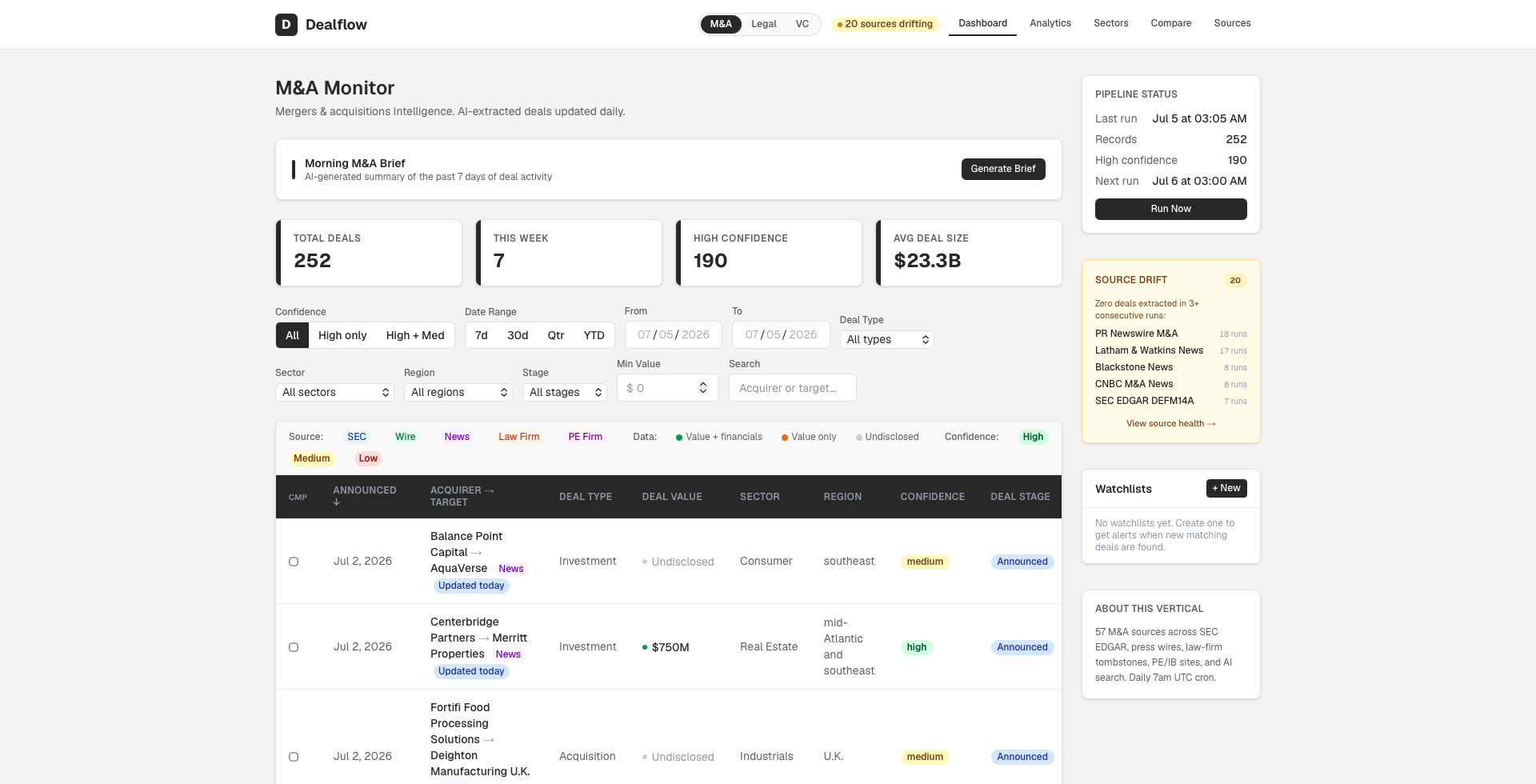
This is a production M&A intelligence platform built as a PwC capstone. An LLM orchestration agent decides which of 51 live sources to crawl on each run, extracts structured deal records from unstructured filings and press wires, enriches them with SEC XBRL financials, and surfaces the results through a dashboard analysts can filter, brief, and export.
The goal wasn't a demo. It was a system that runs on a daily schedule, persists real data — 176 deals in live storage — and replaces a manual research workflow with a self-service intelligence layer.
Tracking M&A activity is a grind of manual sourcing: analysts monitor SEC EDGAR, press releases, law-firm and PE-firm announcements, and advisory wires, then hand-copy deal attributes into spreadsheets with inconsistent formatting.
- The user — deal analysts who need timely, structured M&A intelligence without spending hours sourcing it.
- Why it matters — deal signals are time-sensitive, and manual extraction is slow, inconsistent, and doesn't scale across dozens of sources.
- The gap — no persistent, queryable layer; every question meant a fresh, ad-hoc research request.
An end-to-end agentic pipeline with three moving parts: source selection, structured extraction, and a self-service dashboard.
- Agentic source selection — the LLM reads live source yield scores and chooses which of 51 sources to crawl each run, with targeted 8-K section parsing and MD5 deduplication.
- Structured extraction & enrichment — a 15-field DealRecord extracted with source-specific GPT-4o prompts and Pydantic typing, enriched via the SEC XBRL API for target/acquirer financials and EV multiples.
- Confidence-based persistence — a daily APScheduler cron with upsert logic where higher-confidence re-extractions overwrite lower-confidence records; same-confidence runs only fill null fields.
- Analyst dashboard — filterable deal tables, per-deal LLM one-pager briefs, EV/EBITDA multiples, sector analysis, deal comparison, a 7-day morning brief, and Google Sheets export.
- Inconsistent sources. 51 sources meant 51 formats. Source-specific prompt templates plus keyword pre-filtering and exponential backoff kept extraction reliable without hand-tuning per site.
- Idempotent daily runs. Re-crawling the same deals daily risked overwriting good data with worse. Confidence-based upsert logic made re-runs safe — better data wins, weaker data only fills gaps.
- Financial grounding. LLM-extracted deal terms needed hard numbers. SEC XBRL enrichment attached real financials and computed EV multiples alongside the model's output.
- An "agent" earns its keep when it makes a real decision — here, which sources are worth crawling — not when it just wraps a prompt.
- Confidence scoring isn't just a quality signal; it's the control logic that makes a daily pipeline safe to re-run.
- Next: alerting on high-probability deal-stage transitions, and an analyst feedback loop that tunes extraction confidence over time.