UN-LEX
An enterprise AI assistant, adopted as the department's primary research interface, that lets UN legal officers identify UNDT/UNAT case law by fact pattern or misconduct type — with paragraph-level citations, deployed natively inside Microsoft Teams.
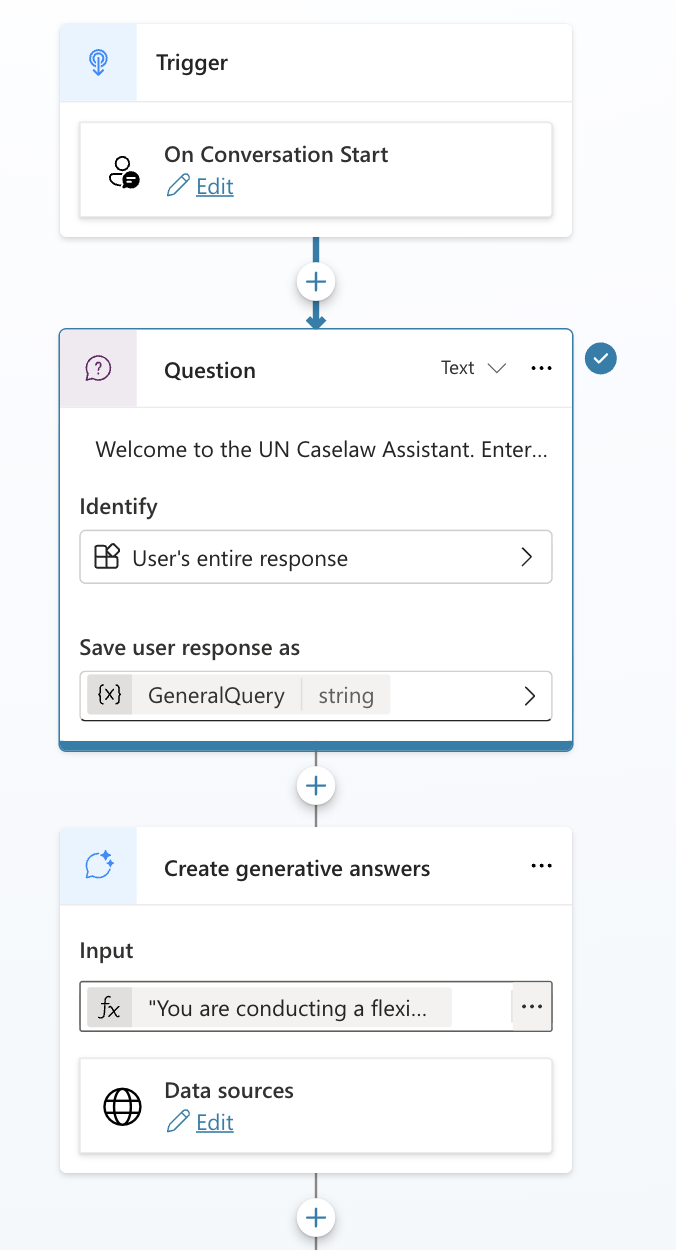
UN-LEX is a production AI research tool built for the United Nations Office of Legal Affairs through a Fordham collaboration. It lets legal officers query 9,000+ UNDT and UNAT tribunal judgments spanning 15+ years of precedent by fact pattern or misconduct type, returning precise, citation-backed answers inside Microsoft Teams.
It was adopted as the department's primary research interface for tribunal case history.
Finding relevant precedent across 15+ years of tribunal judgments meant manually querying databases and reading long-form legal text — slow, expertise-dependent work.
- The user — UN legal officers who need precedent fast and cited precisely enough to rely on.
- Why it matters — research time is a bottleneck, and senior officers' knowledge of the case history is hard to transfer.
- The risk — that institutional expertise walks out the door with attorney turnover, leaving new staff without it.
- Grounded retrieval — an Azure AI Search index over SharePoint-stored judgment PDFs, with a chunking and retrieval strategy tuned for long-form legal text and high citation precision.
- Compound legal queries — multi-condition handling so officers can filter by tribunal, registry, misconduct type, outcome, and time period within a single natural-language prompt.
- Deployed where they work — a Copilot Studio chatbot inside Microsoft Teams with Adaptive Card outputs for structured citations, plus a Microsoft 365 Copilot plugin extended to Word and Outlook.
- Citation discipline — Power Automate middleware enforces UNDT/UNAT-specific citation formatting on every response.
- Long-form legal text. Naive chunking destroys citation precision. The retrieval strategy had to preserve enough structure to point back to the right paragraph.
- Governance. This is UN legal data. Access ran through MS Entra ID with least-privilege permissions, and no personal data was retained in LLM logs.
- Scale headroom. The index was architected to grow from hundreds to 10,000+ documents without structural changes.
- Resisting over-engineering. Early designs reached for elaborate retrieval and routing logic — but the simplest grounded-generation setup over a well-chunked index consistently performed best. Cutting the clever parts improved both the answers and the maintainability.
- In legal AI, the citation is the product. Retrieval that can't point precisely back to source isn't trustworthy no matter how good the prose.
- The simplest thing that works usually wins — the elaborate retrieval schemes lost to a clean, well-grounded baseline.
- Meeting users inside a tool they already live in (Teams, Word, Outlook) matters more than a bespoke UI.
- Next: suggested-precedent surfacing while an officer drafts, and an evaluation harness scoring citation accuracy against a gold set.